

As a supplier of seamless rectangular rings for over a decade, I've learned that the question of how much pressure these small, seemingly simple metal components can hold isn't just an engineering thought experiment-it's a make-or-break detail for every project they go into. From heavy-duty bag handles to industrial equipment mounts, the maximum pressure a seamless rectangular ring can withstand depends on more than just its size or material. Over the years, I've worked with designers, manufacturers, and do-it-yourselfers who've come to my shop frustrated because they picked a ring that failed under load, or they over-engineered a part and wasted money on something way stronger than they needed. Today, I want to break down what actually determines a seamless rectangular ring's pressure limit, and how you can pick the right one for your next job.
First, let's start with the basics: what makes a seamless rectangular ring different from a standard, welded rectangular ring? Welded rings have a joint where two ends of the metal are fused together. Even if that weld is strong, it's always a weak point-especially if you're putting repeated stress on the ring, or if the load is applied unevenly. Seamless rings, on the other hand, are formed from a single, unbroken piece of metal, usually through a process called cold forging or extrusion. That single piece means there's no joint to fail, which is why our seamless rectangular rings are the go-to choice for applications where reliability is non-negotiable. But that doesn't mean they all have the same pressure rating.
The biggest factor in a seamless rectangular ring's maximum pressure is its material. We make most of our seamless rings from zinc alloy, a popular choice because it's affordable, durable, and corrosion-resistant. But not all zinc alloy is the same. Our standard zinc alloy seamless rings are great for light to medium loads-think bag hardware, craft projects, or light-duty clothing accessories. But for heavier applications, like industrial tie-downs or heavy-duty bag handles, we also offer heavier gauge zinc alloy, or even stainless steel seamless rings. Stainless steel is stronger and more corrosion-resistant than zinc alloy, so a stainless steel ring can hold significantly more pressure than a zinc alloy ring of the same size.
Next is the ring's dimensions, and specifically its aspect ratio. For example, a ring that's 2 inches wide with a 1/8-inch thick metal bar is going to hold less pressure than a ring that's 2 inches wide with a 3/16-inch thick bar. The thickness of the metal (called the "wire gauge" or "bar diameter") is one of the most direct factors in pressure resistance. The width and length of the ring also matter. If you have a long, narrow rectangular ring, the load is spread over a longer distance, which can put more stress on the sides of the ring, whereas a square or short, wide rectangular ring distributes the load more evenly. I always tell customers to think of it like a bridge: a longer beam needs to be thicker to hold the same weight as a shorter beam. The same goes for a seamless rectangular ring.
Then there's how the load is applied to the ring. This is a part of the equation that a lot of people overlook. A seamless rectangular ring that's pulled evenly on two opposite sides will hold far more pressure than the same ring that's pulled at an angle, or has a load concentrated on one corner. For example, if you're using a ring as a connector for a bag handle, and the handle is sewn directly to the top of the ring, the load will pull straight down on that corner. That creates a point of stress concentration, which can lower the maximum pressure the ring can hold. On the other hand, if you use a ring that's designed to have the load spread across the top bar of the rectangle, the stress is distributed, and the ring can hold more. That's why we often recommend our seamless rectangular rings paired with our U-Shaped Bag Handle Connector, a component that wraps around the ring and spreads the bag handle's load evenly across the top bar. It's a small addition, but it can double the effective load capacity of the ring.
Let's get into some actual numbers, because that's what most people want to know. But I have to be clear here: these are general guidelines, not hard and fast rules, because every application is different. For our standard zinc alloy seamless rectangular ring, which is 1 inch wide with a 1/8-inch thick bar, the maximum tensile strength (that's the maximum pressure it can hold without breaking) is roughly 200 pounds. That's for a load applied evenly along two opposite sides, under ideal conditions. If the load is applied to a single corner, that drops to around 120 pounds, because of that stress concentration. If you go up to a 2-inch wide zinc alloy ring with a 3/16-inch thick bar, the maximum tensile strength jumps to around 400 pounds for even load, and 250 pounds for a corner load. For a stainless steel seamless rectangular ring of the same dimensions, that number goes up to 700 pounds for even load, and 420 pounds for corner load.
But wait-those numbers are for tensile strength, which is the static pressure the ring can hold without breaking. What about dynamic load, like when you're carrying a heavy bag that's bouncing, or a tie-down that's being shaken by wind? Dynamic load is where a lot of rings fail prematurely, because metal fatigues over repeated stress. Our seamless rectangular rings are designed to handle dynamic loads, but their effective pressure limit under repeated stress is about 30-40% lower than their static tensile strength. So if a ring has a static capacity of 200 pounds, you can safely carry about 120-140 pounds on it over and over again without it breaking. That's a critical point for anyone using these rings for everyday carry or applications where the load isn't constant.
I've seen this play out many times with customers. Last year, a small bag designer came to me with a prototype for a heavy-duty travel tote. He was using a standard welded rectangular ring, and the top handle broke when he put 150 pounds of books in the bag. He switched to our 2-inch zinc alloy seamless rectangular ring, paired with our U-Shaped Bag Handle Connector, and his testing showed it held 300 pounds without any issues. He later told me that ring is now used in over 10,000 totes a year, and he hasn't had a single failure. That's the kind of result we love to see-our seamless rings solving real problems.
Another example: a construction supply company came to us needing rings for tie-down straps on heavy equipment. They initially ordered our standard zinc alloy seamless rings, but after testing, those failed at 250 pounds under dynamic load. We suggested they switch to our heavy-duty zinc alloy seamless rectangular rings, which have a thicker bar and higher tensile strength. Those held up to 500 pounds of dynamic load, which was exactly what they needed. That's why it's so important to match the ring's capacity to your actual application. You don't want to buy a ring that's too weak, but you also don't want to waste money on an over-sized, over-strong ring that costs twice as much as you need.
Now, let's talk about other factors that can affect a ring's pressure capacity. Corrosion is a big one, especially if the ring is going to be used outdoors or in a wet environment. Zinc alloy is corrosion-resistant, but it can tarnish over time, especially if exposed to salt water or harsh chemicals. Stainless steel is more corrosion-resistant, but it's also more expensive. If you're using a ring in a humid climate or for marine applications, a stainless steel seamless rectangular ring will hold up much better over time, maintaining its pressure capacity, than a zinc alloy ring that could weaken as it corrodes. Surface finish also plays a role-our rings come in a variety of finishes, from polished to powder-coated, and while the finish doesn't change the metal's strength, a rough or worn surface can create tiny stress points that can lead to failure. That's why all our seamless rings are finished to be smooth and uniform, no sharp edges that could compromise performance.
I should also mention that not all seamless rectangular rings are created equal. Some manufacturers cut corners by using thinner metal, or lower quality alloys, to make their rings cheaper. Our seamless rings are made using a precision cold forging process, which ensures that the metal's grain structure is aligned, making it stronger than rings that are made by stamping or cutting from a flat bar. That process gives our rings consistent, reliable strength, which is why we stand behind every one we sell. If you've ever used a low-cost ring that bent or broke after a few uses, you know how frustrating that is-we design our rings to avoid that.
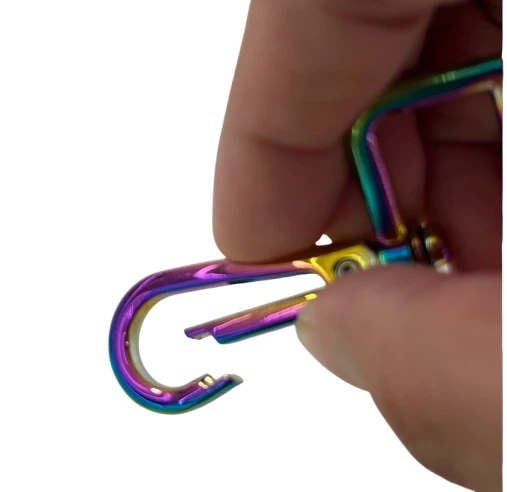
Let's also look at how seamless rectangular rings compare to other ring types, because that often helps customers decide what they need. For example, our Diamond Dotz Ring is a smaller, decorative ring that's perfect for light craft projects, jewelry, or small bag accents. Its maximum pressure is around 50 pounds, which is way less than a standard seamless rectangular ring, but that's because it's designed for lightweight use. Our Zinc Alloy Rotating Trigger Snap is another type of ring-this one has a snap closure, making it great for quick attachment. It's a bit more complex, so its maximum pressure is around 150 pounds, which is still solid for many applications. The Rainbow Swivel Snap Hook is similar, with a swivel function, and its pressure capacity is around 200 pounds, making it a good choice for rotating handles or straps. And for really heavy applications, our Heavy-Duty Zinc Alloy D-Ring is a great option-its D-shape distributes load well, and it can hold up to 600 pounds of static pressure, which is more than enough for most heavy-duty uses.
I've had customers ask me if you can increase a ring's pressure capacity by reinforcing it. For example, wrapping it in leather or adding a metal strap. That can help, but it's important to do it right. If you wrap the ring in a way that creates sharp bends or uneven stress, it can actually make the ring weaker. The best way to reinforce a seamless rectangular ring is to distribute the load evenly, which is where components like our U-Shaped Bag Handle Connector come in. That component wraps around the ring, so instead of the load pulling on a small part of the ring, it's spread across the entire top bar, reducing stress and increasing the ring's effective capacity.
Another common question: what about when a ring is bent or deformed? Once a seamless rectangular ring is bent, its pressure capacity drops significantly, because the bending creates stress points in the metal. That's why it's important to use a ring that's sized correctly for the load, so you don't have to stretch or bend it to fit. For example, if you're attaching a ring to a bag, making sure the ring fits the handle's width without being too loose means the load is applied evenly, not unevenly across the sides of the ring.
So, putting all this together, what's the maximum pressure a seamless rectangular ring can withstand? The short answer is: it depends. For a standard zinc alloy seamless ring, around 700 pounds of static tensile strength at the high end, and for stainless steel, up to 1,200 pounds. But those are the extremes. Most applications fall in the 100-500 pound range, depending on size, material, and load application. The real takeaway is that the maximum pressure isn't just a number-its your specific application's load, environment, and how you attach the ring all matter just as much.
If you're not sure which seamless rectangular ring is right for your project, that's what we're here for. We've worked with hundreds of customers, from small boutique designers to large industrial manufacturers, and we can help you find the ring that has exactly the pressure capacity you need, without overpaying for something you don't. Whether you're making a heavy-duty travel bag, industrial tie-downs, or craft supplies, our team can walk you through the options, including our complementary hardware like the U-Shaped Bag Handle Connector, Diamond Dotz Ring, Zinc Alloy Rotating Trigger Snap, Rainbow Swivel Snap Hook, and Heavy-Duty Zinc Alloy D-Ring, to make sure your final product is safe and reliable. Don't guess-let us help you pick the right seamless rectangular ring for your needs. Contact us to discuss your project and get a custom quote tailored to your pressure and performance requirements.
References:

- Metals and Materials International. (2020). "Tensile Strength and Fatigue Behavior of Zinc Alloy Alloys for Hardware Applications." Journal of Materials Engineering and Performance.
- American Society of Mechanical Engineers (ASME). (2018). "Design Guidelines for Rigging Hardware and Load Rings." ASME B30.26 Standard for Rigging Hardware.
- Manufacturing Process Journal. (2021). "Cold Forging vs. Stamping: Effects on Metal Component Strength." International Journal of Precision Engineering and Manufacturing.
- Leathercraft News. (2022). "Load Distribution in Bag Hardware: Minimizing Stress Concentrations in Rings and Connectors.
- Stainless Steel Industry Association. (2019). "Corrosion Resistance and Load Capacity of Stainless Steel Hardware for Outdoor Applications.


